


What is risk? Simply put, risk is the likelihood that something bad will happen, and how severely it could impact you.
As much as we’d like to remove it from our lives, risk is impossible to avoid, and focusing on it too much can be dangerous.
If you hyper-focus on avoiding one risk, you may unknowingly take on another. For example, a portfolio that is too conservative will expose you to a higher risk of loss of purchasing power because it will not be able to keep up with inflation. On the other hand, a portfolio that is too aggressive will expose you to a higher risk of losing your money because your investments will not be diversified enough.
It helps to look at your risks together rather than one at a time. Taking inventory of what you are actually facing makes it easier to decide where to focus, and this can be especially helpful when it comes to retirement.
Retirees face four primary risks in retirement:
1.Longevity Risk
Longevity risk addresses the number one concern of retirees: That they will outlive their savings.
Life expectancy is higher than ever. According to the latest numbers from the CDC, the average lifespan is 81.4 years for women and 76.5 years for men. It is worth considering that your life expectancy increases with every year you live. The average 65-year-old woman has a life expectancy of 86, plus a 40% chance she’ll reach age 90.
Most typical financial plans assume a 30-year time horizon for people who retire at 65, meaning they are intended to provide for the retiree until the age of 95. That used to be a conservative estimate. But with increasing lifespans, experts say that the chance of living beyond age 95 is 20% for women and 10% for men.
That doesn’t necessarily mean every financial plan needs to account for a 40-year retirement. The Census Bureau reports that only 0.02% of the population – roughly 80,000 people – are over the age of 100. That being said, you still want to plan in case, especially if your family has a history of people with long lifespans.
2. Investment Risk
People often don’t want to invest because it feels risky to them. It’s true, risk is an essential part of investing. Without risk, there can be no returns, and the bigger the risk, the bigger the potential returns.
The good news is that you can increase and decrease risk according to your needs. By setting goals and building a financial plan, an advisor can help you tailor the amount of risk you have to take to help you accomplish your goals.
Investments always carry risk, regardless of your age. But as you get older, that risk increases because you have a shorter time horizon within which your investments can recover.
It took roughly 5.5 years for the markets to recover after the 2008 financial crisis wiped out $3.4 trillion in retirement savings. While that time was difficult for most people, those in or near retirement were in a much worse position because their earning years were behind them. They were largely dependent on the markets.
In retirement, you are withdrawing from investment accounts. If your investment accounts sharply decrease in value and you continue to withdraw from them, then it becomes that much harder for them to recover and your 30-year retirement egg may become a 25-year egg overnight.
The greatest investment risk is during what some experts call the “fragile decade” – the five years before and after you retire. If the markets experience a significant downturn at that time, the impact on your portfolio will be greater than any other time. This is known as sequence of returns risk.
Flexibility is key in combatting investment risk. What’s your plan B if the markets tank right when you want to retire? A lot of people opt to go back to work, or reprioritize which accounts they will withdraw from in retirement.
3. Inflation Risk
Did you know that a 3% inflation rate will cut the purchasing power of a dollar in half over the course of 24 years? That’s one of the main reasons investing is such an important part of your financial plan. The S&P 500 has an average annual return of 10%, which helps your money stay ahead of the rate of inflation.
4. Health Risk
Health concerns are a major expense in retirement. According to one recent study, the average American retiree will spend $185,500 on healthcare-related expenses in retirement, and that does not include long-term care, which can cost more than $100,000 on average.
If you are not prepared for it, a single unexpected diagnosis can impact your ability to enjoy your retirement.
While financial security can help protect you in case of hospitalization or extensive treatments, the best defense against health issues is doing things that increase your “healthspan” – e.g., strength training, mobility training, good nutrition, etc.
How to Manage the Risks of Retirement
The key to managing risk in retirement is to be strategic, understand your risk profile, and focus on what you can control.
Have you ever heard the Serenity Prayer? When I read it, it seems clear to me that it was written by someone who was struggling with the inherent risk in life. It goes like this:
Grant me the serenity to accept the things I cannot change, the courage to change the things I can, and the wisdom to know the difference.
The 2 Levers You Can Pull to Find Serenity in Retirement
If finding serenity amidst all of the risk in retirement feels impossible, I find that breaking down risk to its two components can help clarify the difference between what I can and cannot control.
Lever #1: The Probability that Something Will Happen
What is the probability, or likelihood, a bad outcome will occur? More importantly, what can I do to lower the probability of this bad outcome occurring?
When riding a bike, there is always the potential of getting in an accident. Still, you can do things that increase or decrease such a likelihood. If you wear headphones that block out external noises so you can listen to music, you increase your chances of getting in an accident. By not wearing headphones, you decrease your chances.
Of course, there’s nothing you can do to eliminate the possibility that a bike accident might happen, short of never getting on a bike in the first place.
Driving a car is a risky endeavor, but we do it every day. You have a variety of tactics you can use to lower the probability of getting in an accident: Mind the speed limit, avoid aggressive drivers, avoid making emotional decisions, not drive during snowstorms, drive when it’s bright outside, etc.
It’s the same way when it comes to investing. The risk of losing money is always present, but you have levers you can pull to help mitigate the probability of that happening, such as diversification, market research, working with a financial advisor, etc.
Lever #2: The Impact of the Potential Loss
Most bicyclists today wear helmets when they ride, but not because it decreases the likelihood they will get in an accident. Helmets do nothing to change the probability of an accident, but they decrease the potential severity of an accident by protecting your head.
There are also some ways to decrease both the probability and potential, such as the speed you go on your bike. The slower you go, the lower the likelihood of an accident, and the lower the potential damage such an accident would cause.
The most obvious financial parallel here is insurance. Having flood insurance does nothing to decrease the probability of a flood, but it reduces the potential impact because you would be reimbursed for associated costs.
Tools like diversification, behavioral coaching, and even something as straightforward as a financial plan can also make a huge difference in how much a negative event impacts your retirement savings.
Pull the Right Levers at the Right Time
As we already understand, we cannot eliminate all risks all the time. The next best thing is to recognize the risks that have the highest probability and highest impact based on which season of life you’re in.
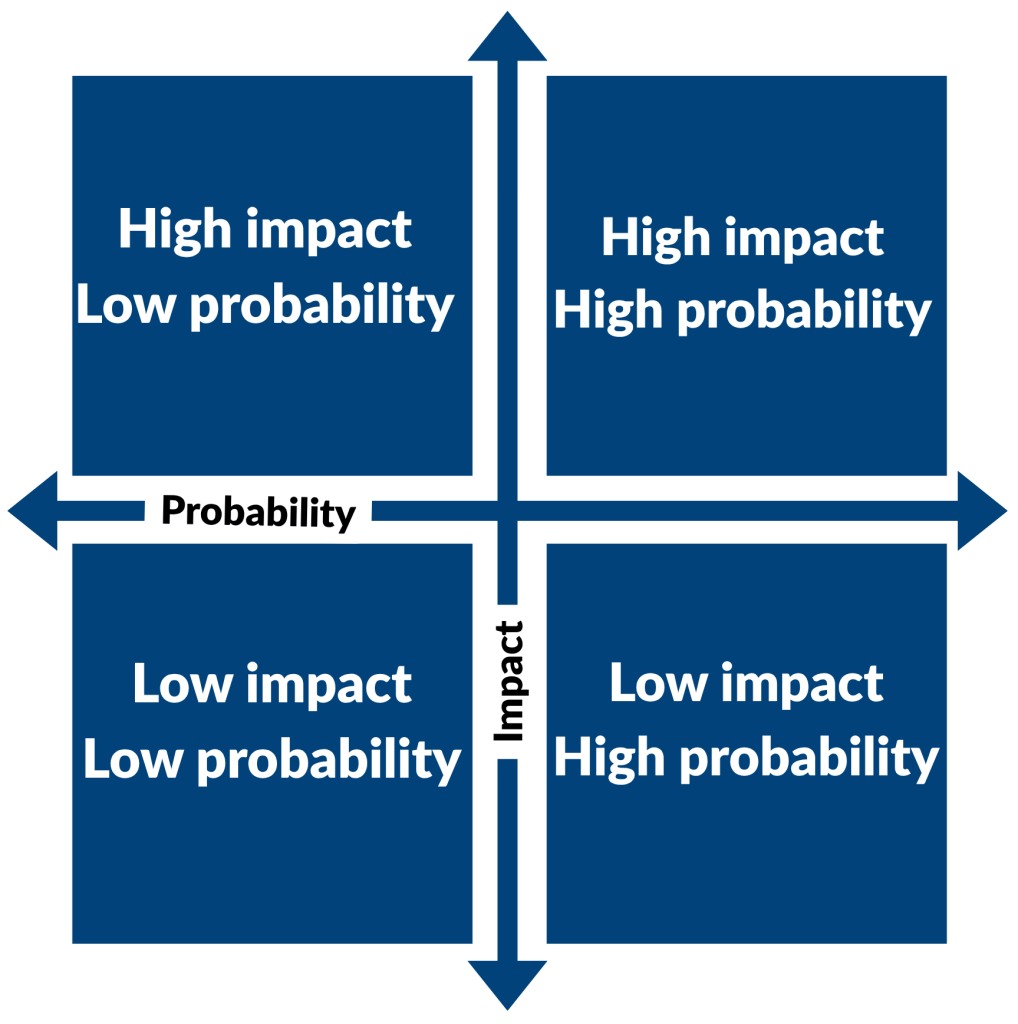
For instance, a market downturn would have a bigger impact in the early years of retirement than it would later on. As a result, your financial plan should aim to withdraw from your savings accounts and leave your investment accounts alone early in retirement and then switch that approach with time.
The quadrant we should focus on in the above illustration is the top right: high impact, high probability. All too often, we easily become distracted by the wrong quadrant, particularly high impact, low probability.
Fear sells – it was true in the days of newspapers and it is even more true in the days of online news. A 2024 study from the Brookings Institution found that media coverage of financial issues was overwhelmingly negative relative to what reality reflected. From a purely business perspective (to say nothing of ethics), this is a savvy move on the part of the media because each negative word in a headline increases clicks by 2.3%.
Most experts agree that there have been roughly seven true stock market “crashes” in the last 100 years. But if you went by the daily headlines, you’d think we were constantly on the verge of another Black Monday.
In addition to the low likelihood of something like this occurring, how realistic is it that we can actually prepare for a worst case scenario? When Covid hit, no one was ready. In the likelihood that the food supply chain breaks down (or some other doomsday scenario), we’re all in this together. You won’t be the only one trying to figure out how to find chickens to lay eggs so you have food.
Rather than focus on the low likelihood of impending doom, which we could never properly prepare for anyway, it’s best to look at something that is more likely. For instance, the markets go down frequently – how can you fortify your portfolio against that? In the end, the impact of a market dip is lower than a total disaster, but it is much more likely.
Risk will always be part of retirement, and no plan can remove all of it. Instead, you can lower the probability that something goes wrong, and limit how much it affects you if it does.
Which of these levers matters most will change with the season of life you are in, so it is worth revisiting them as the years go by. With that in mind, you can approach retirement with the serenity to accept what you cannot change and the courage to act on what you can.
We can help you think through the risks in retirement
If you want help addressing the four retirement risks, and more, reach out to schedule an initial conversation. We would love to discuss how we may be able to help.

